NDH Discoveries is a project generator focused on detecting cryptic alteration systems using hyperspectral imagery, an overlooked opportunity in a new search space. Targets that are generated by NDH Discoveries can be followed up quickly and inexpensively, shortening time and budgets that are needed to test them with the drill bit. We build partnerships with other companies (miners and junior explorers), to move these targets forwards, while we keep exposure to the potential upside. Our team’s unique experience allows us to generate targets that have a much better odds of discovery than the average prospect.
Cryptic alteration, an overlooked exploration opportunity
Every new mining district started with a prospect. From Malachite Creek at Batu Hijau to Turquoise Hill at Oyu Tolgoi, visible indications of mineralization have been the beginning of the discovery process. At NDH Discoveries we are convinced that there are numerous major, near surface ore deposits that have yet to be discovered, because the exposed alteration mineralogy is not easily identifiable visually. Our focus is on recognizing the cryptic alteration that has kept overlooked ore deposits ´hidden in plain sight´.
By cryptic alteration we refer to specific alteration minerals and subtle changes in chemistry and crystallinity of certain minerals, that we can map quickly and accurately using our proprietary methodology, but which cannot be easily recognized in the field, or by other exploration methods. A key aspect of cryptic alteration is that the surface indications do not match patterns of alteration and geomorphology that are typical indicators of mineralization. In those settings, experience and bias can work against success, and even the most experienced field geologists can wear blinders to unconventional expressions of hydrothermal systems. Recent discoveries in Nevada, such as Merlin/Silicon (renamed to Arthur) and Fourmile, show that it is still possible to make large, high grade discoveries, even in areas that have been actively explored for over a century.
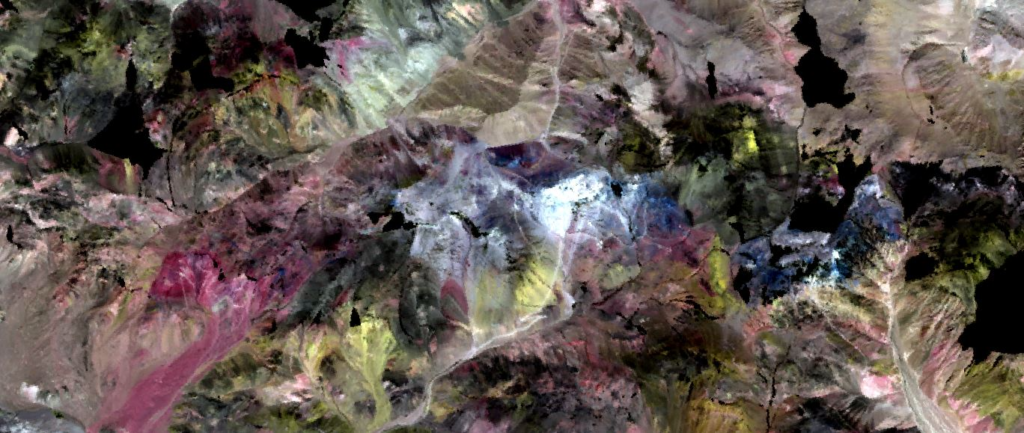
NDH Discoveries looks at the Earth without geologic blinders. Hyperspectral technology allows us to identify and map cryptic alteration that is invisible to human eyes, and important variations in mineralogy and crystallinity within exposed alteration systems. Opportunities include areas where alteration minerals are too fine grained to be visually recognizable, or that don’t fit conventional geomorphic and/or “colour anomaly” presentation. Accurately mapping the mineralogy of the “altered white mush” makes a difference in understanding a system, or even recognizing that a system exists. For example in epithermal systems, some important alteration minerals are very difficult or impossible to identify through visual alteration mapping. Over several decades, the team at NDH Discoveries has built the tools and skills to rapidly exploit cryptic alteration opportunities that have been overlooked by previous explorers because of geological bias.
New primary spatial datasets – opening up new search spaces
You often hear (especially from geophysicists), “all of the exposed ore deposits have been discovered, you need to look under cover for new deposits”. Our core philosophy is contrary to this conventional wisdom – we believe there are still numerous undiscovered ore deposits hiding in plain sight.
High-quality (VNIR & SWIR) hyperspectral imagery is opening up a new search space that will provide many overlooked near-surface targets. These new hyperspectral datasets enable the quick and accurate mapping of exposed alteration systems over large areas. The coverage of this new, primary spatial dataset over important metallogenic belts continues to grow every day.
NDH Discoveries is well positioned to take advantage of this opportunity, because of our combined experience in working with similar datasets. The founders have a long history of extracting accurate geological information, relevant for exploration, from airborne hyperspectral imagery (VNIR & SWIR), field spectrometer measurements and scanned drill core. Existing coverage of airborne hyperspectral imagery is sparse and few (if any) geologists have as much relevant experience with hyperspectral imagery for mineral mapping and exploration, as the NDH Discoveries team. Our proprietary methods do not create the false positives that are abundant in more commonly used mineral mapping techniques. NDH is using these methods to quickly turn hyperspectral imagery into clear exploration targets. Through our specific focus on mapping cryptic alteration at surface, we generate exploration targets that could not be recognized previously, with other datasets.
In addition, there is a second completely new search space where NDH Discoveries has a first mover advantage. Our team has unique knowledge of the long-wave infrared (LWIR), which further increases our capability to detect previously unrecognized alteration. For projects and areas where lower resolution satellite imagery indicates appropriate geological setting and target deposit styles, NDH Discoveries will acquire airborne LWIR hyperspectral imagery (alongside high resolution VNIR & SWIR data). The LWIR spectral data enables the accurate mapping of further cryptic alteration, including additional minerals and chemical variations in, for example, quartz, and groups such as feldspars, carbonates and garnets. The LWIR has so far only seen limited use in exploration, and our team has been at the forefront of its application in mineral exploration.
Quick evaluation, reduction of exploration timelines and costs
Greenfield exploration success requires the screening of a large number of prospects, quickly and economically. Unlike many geophysical methods, our approach allows rapid, low-cost evaluation through surface sampling. The application of our proprietary hyperspectral methodology allows us to speed up exploration, by:
– Screening large areas rapidly, effectively and consistently
– Identifying the most prospective parts of alteration systems, and understand their geologic context
– Quick sampling of key outcrops, soils & streams in the identified alteration systems
– Evaluating and prioritizing targets without requiring extensive use of other time-consuming and expensive methods (geophysics, ‘scout’ drilling, etc.)
Our approach is focused on the efficient deployment of capital. It allows for the rapid evaluation of targets, which shortens the decision time to progress or drop a prospect. A clear workflow to save time and money, while still thoroughly evaluating target areas.
Area selection using the Mineral Systems framework
The increase in hyperspectral sensors is the reason for starting this venture now, but our exploration approach is not limited to detecting cryptic alteration assemblages in a vacuum. to increase the odds of meaningful discoveries at the targets that we generate, we apply the mineral systems approach to exploration, to determine which regions to focus on. Geological remote sensing plays a key role in building our understanding of the individual components of mineral systems.
A major benefit of geological remote sensing is that it allows us to move quickly across different scales, with datasets that are consistent from the large regional scale, down to detailed mapping at the scale of individual mineralized structures. This enables the selection of prospective belts, the recognition of translithospheric structures within those belts, and transcrustal fault zones connected to these translithospheric structures, which form possible pathways for vertical flow of fluids through the crust. The spectral analysis and interpretation help us recognize the locations along those structures with evidence of significant hydrothermal fluid flow. Our approach will generate targets for which two key exploration questions have already been answered:
1. An understanding of major, steeply dipping structures that are possible locations of increased permeability in the crust,
2. The presence of high-temperature alteration assemblages, which is evidence of significant hydrothermal fluid flow.
NDH Discoveries will initially focus on regions where the fertility component of mineral systems has already been confirmed. Within those regions, the goal is to find deposits with a cryptic alteration footprint that have remained hidden ‘in plain sight’. This opportunity exists because the alteration that we focus on cannot be (easily) recognized in outcrop by field geologists, or through the application of other commonly used exploration methods. We fully recognize the log-normal distribution of deposit size in terms of total metal content. Our approach allows us to generate a large number of targets, to improve the likelihood that some may fall in the long tail world class end of the distribution. By targeting higher temperature alteration mineral assemblages we are more likely to bias targets toward this favorable end of the distribution.
Leveraging partnerships
NDH Discoveries is a private company, specifically focused on the initial stages of exploration, prior to an initial drill program. We select overlooked, prospective ground, and after confirming the presence of anomalous metal geochemistry, NDH transfers these projects on to capable partners for more detailed exploration efforts. NDH keeps exposure to the upside, to benefit from the discoveries that are made by our partners. Deals on individual projects, and exploration alliances focused on specific regions, are set up in a way that is mutually beneficial to both NDH and our partners.
Contact Us
Do you ave a question? Would you consider a partnership with NDH Discoveries?